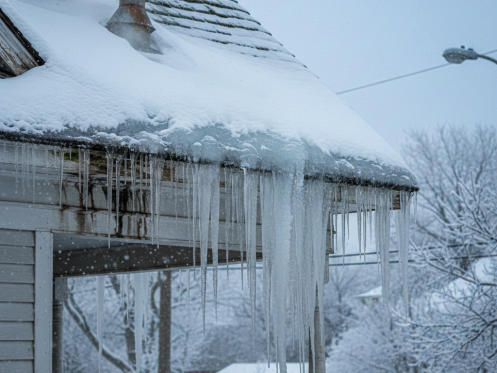
A single cold snap does not usually cause serious ice dam damage. The real trouble starts when severe winter weather stretches over days and weeks, cycling between freezing and partial thawing while snow piles higher on the roof. Each time that cycle repeats, the damage pushes a little further — under shingles, into the roof deck, behind walls. On an aging roof that has already lost some of its original protection, the process accelerates in ways that catch homeowners off guard.
Here is how extreme cold drives ice dam damage on older roofs, and why waiting to address it makes everything more expensive.
What Freeze-Thaw Cycles Actually Do to Shingles
When water freezes, it expands by roughly 9% in volume. That number sounds small, but the damage comes from where it happens and how many times it repeats. During a typical central Indiana winter, temperatures swing above and below 32°F dozens of times between November and March.
Here is the sequence on an aging roof: daytime warmth or attic heat loss melts snow on the upper roof surface. Meltwater seeps into the fine gaps between shingles, under flashing edges, and around nail heads. When the temperature drops overnight, that trapped water freezes and expands, physically prying the gap wider. The next day, the ice melts and the water moves deeper into the newly widened opening. Then it freezes again, expanding again, pushing further.
After ten or twenty of these cycles, a hairline gap that was barely visible in October has become a reliable entry point for water. On a newer roof with intact adhesive strips and sealed underlayment, those initial gaps are smaller and the barrier layers hold longer. On a roof that is 20 or 30 years old, the asphalt has already stiffened, the adhesive bond between shingle tabs has weakened, and original caulking around flashing has dried out. The freeze-thaw cycle does not create problems from nothing — it exploits weaknesses that already exist. Older roofs simply have more of them.
How Snow Buildup Traps Moisture at the Roof Edge
Snow sitting on a roof does more than add weight. It acts as an insulating blanket that changes how heat moves through the roof system.
On a well-insulated home, the roof deck stays close to outdoor temperature and snow does not melt from underneath. On an older home with thin or settled insulation, heat escaping from the living space warms the roof deck enough to melt the bottom layer of snow even while the air temperature is well below freezing. That hidden meltwater runs downhill until it hits the eaves — the overhang beyond the exterior walls — where it refreezes into a growing ridge of ice.
Heavy snowfall compounds the problem. A thick snow layer insulates the roof more effectively, which actually raises the temperature of the roof deck underneath and speeds up melting. Meanwhile, the ice dam at the edge keeps growing because the eaves remain cold. More melt is generated above, more ice forms below, and the pool of trapped water between them deepens.
On an aging roof, this pooling water finds entry points quickly. Older shingles loosened by years of thermal movement offer less resistance. Homes built before the mid-1990s often have no ice and water shield at the eaves, which means the only barrier between pooled meltwater and the roof deck is the shingle layer itself. Once standing water gets past the shingles, it soaks into the plywood sheathing. Wet wood swells, and when it freezes, the expansion stresses the fasteners holding the sheathing to the rafters.
Why Extended Cold Makes Everything Worse
A brief cold spell followed by a full thaw is actually less damaging than a prolonged stretch of severe cold interrupted by occasional warm days. The worst conditions for ice dam damage are sustained periods where the temperature stays low enough to keep ice dams in place but occasionally rises just enough to generate more meltwater.
Central Indiana regularly sees this pattern: several days in the teens, followed by a day or two near 35°F, then back down again. Each warm day feeds the ice dam with fresh meltwater. Each drop back below freezing locks that water in place under shingles or in the gaps it has already penetrated. The dam never fully melts. The water supply keeps coming.
Extended cold also stiffens the roofing materials themselves. Asphalt shingles become brittle and more prone to cracking under the weight of expanding ice. Rubber boots around plumbing vents harden and shrink, opening gaps. Metal flashing contracts, sometimes pulling away from sealed surfaces. All of these small changes create new entry points that would not exist in milder conditions.
This is why two winters are never the same when it comes to ice dam damage. A mild winter may cause no visible problems. A hard winter with deep cold, heavy snow, and repeated freeze-thaw swings can expose every weak point an aging roof has — all at once.
What Happens When Repairs Get Delayed
One of the most expensive decisions homeowners make with ice dam damage is deciding to wait. The reasoning is understandable: the roof has held up so far, the damage is not visible from the outside, and repair costs are hard to absorb mid-winter. But delayed repairs almost always cost more than the original problem.
Here is how the escalation typically works on an aging roof.
Season one: Meltwater from an ice dam finds its way past a few compromised shingles. A small amount of water reaches the roof deck. It dries out during warmer months. No visible damage inside the house.
Season two: The same entry points are wider from last winter’s freeze-thaw action. More water gets in. Insulation near the eaves absorbs moisture. Because wet insulation transfers heat more efficiently, the roof deck above it warms faster, generating more meltwater and feeding the ice dam. A faint stain appears on the ceiling but fades in spring.
Season three: The roof deck has started to soften in spots. Insulation is compressed and deteriorated. The ice dam forms faster and grows larger because the insulation is failing in that area. Water stains return. Paint bubbles on an upper wall. A musty smell develops in the attic. Mold may be establishing itself on the damp sheathing.
What started as a shingle-level repair has become a roof deck replacement, insulation removal and reinstallation, potential mold remediation, and drywall repair. Minor ice dam repairs — replacing a few shingles, resealing flashing — typically run a few hundred to around $1,500. Once water has damaged the roof deck, saturated insulation, and triggered mold, costs can climb to $5,000 to $10,000 or higher. Full roof replacement on a standard Indiana home frequently runs $10,000 to $25,000 when structural damage is involved.
Each season of inaction adds a layer of cost that stacks on top of the last one.
What Homeowners Should Do Before the Next Hard Freeze
If your roof is 15 years old or more and you have experienced ice buildup or any interior moisture during cold weather, the most cost-effective step is a professional roof and attic evaluation before next winter. That evaluation should cover the condition of shingles at the eaves, the state of flashing and sealant around penetrations, whether ice and water shield exists at the eave line, current insulation depth near exterior walls, and whether attic ventilation is functioning properly.
Addressing problems during warmer months — when materials are workable, access is safe, and contractors are not backed up with emergency calls — costs less and produces better results than repairs during a January ice storm.
Nationwide Contracting provides professional roof inspections, repairs, and full replacements for homeowners across Indiana. If your roof has been through more than a few hard winters and you are not sure where it stands, call (463) 363-1003 or schedule an evaluation online before severe cold puts it to the test again.